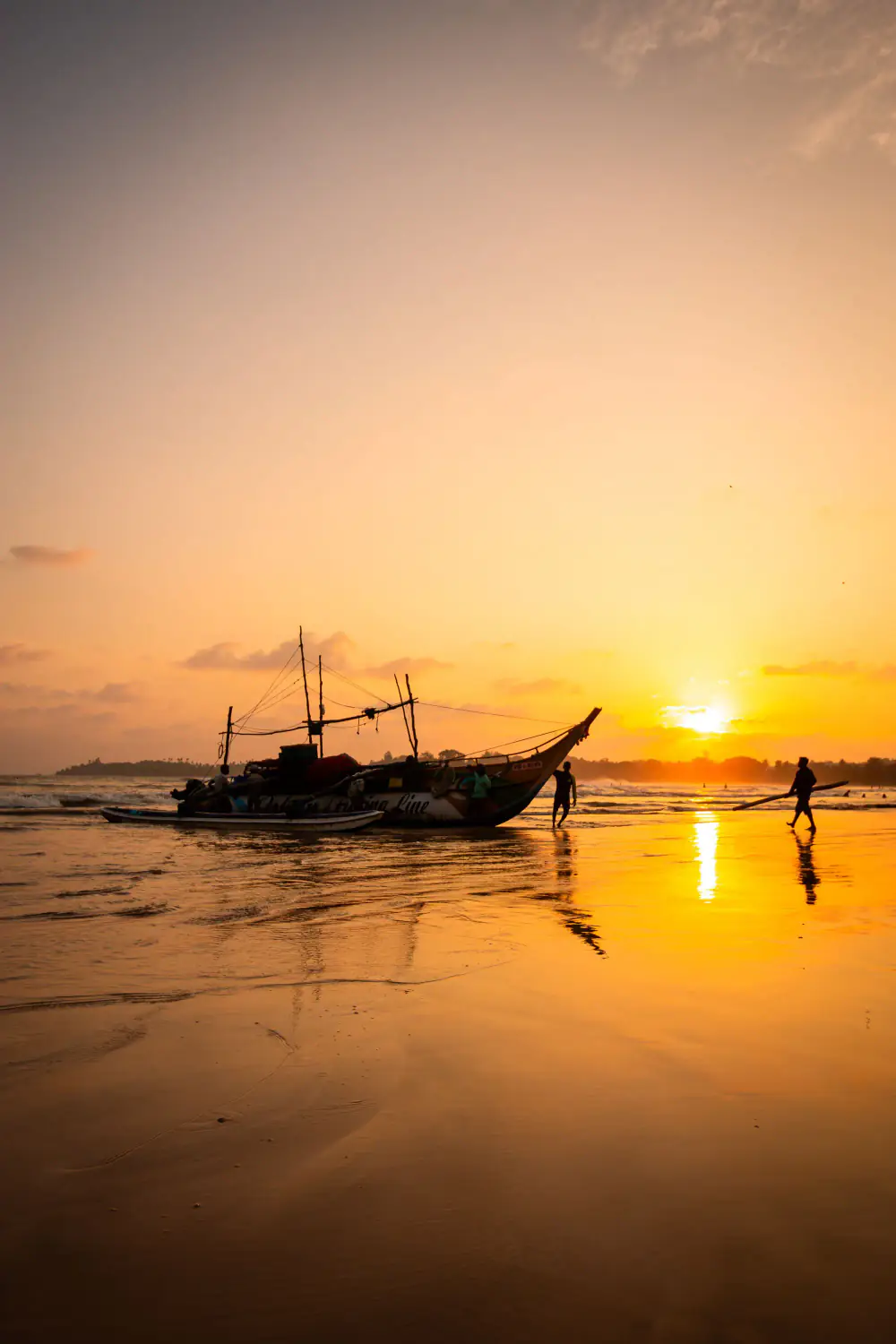
Whale Watching
Plan whale watching as a regulated marine activity: verify the location, weather, licensed operator, vessel safety and wildlife-observation practices.
Yes, November and December are in season on the south coast: the Sri Lanka Navy lists cruises from Galle, past Mirissa and Dondra Head, from November to April (schedule last fully tabulated 11 October 2026; home page re-read 17 October 2026). The Department of Meteorology expects above-normal rain in November 2026, which can mean rougher seas.
Whale watching in Sri Lanka depends on the month. The Navy runs from Trincomalee from May to October. Whichever coast you pick, it is a regulated boat trip, not a guaranteed sighting, and no source on this page names a blue-whale calendar. Check marine conditions, the operator's licence and how the boat follows the Sea Mammals Observation Regulations. For placing Mirissa in a wider route, see the south coast hub.
Mirissa vs Trincomalee by month
This table uses the Sri Lanka Navy's published whale-watching schedule, checked on 11 October 2026, for Mirissa and Trincomalee. The Kalpitiya column is not a Navy calendar: Kalpitiya Diving Center, read 17 October 2026, gives spinner dolphin pods from November to mid-April. It is not a sighting forecast, and private operators set their own dates.
| Month | Mirissa / south coast | Trincomalee / east coast | Kalpitiya (dolphins, operator) |
|---|---|---|---|
| January | Navy southern season | Not in Navy season | Kalpitiya Diving Center window |
| February | Navy southern season | Not in Navy season | Kalpitiya Diving Center window |
| March | Navy southern season | Not in Navy season | Kalpitiya Diving Center window |
| April | Navy southern season | Not in Navy season | Through mid-April, per Kalpitiya Diving Center |
| May | Not in Navy season | Navy Trincomalee season | Not in that operator window |
| June | Not in Navy season | Navy Trincomalee season | Not in that operator window |
| July | Not in Navy season | Navy Trincomalee season | Not in that operator window |
| August | Not in Navy season | Navy Trincomalee season | Not in that operator window |
| September | Not in Navy season | Navy Trincomalee season | Not in that operator window |
| October | Varies. Navy notices started the southern season in October 2017 and on 6 October 2018 | Varies. Listed in the schedule; the 2017 notice ran to the end of October, the 2018 and 2023 notices ended in September | IWC lists spinner dolphins October to March; not a Navy calendar |
| November | Navy southern season | Not in Navy season | Kalpitiya Diving Center window |
| December | Navy southern season | Not in Navy season | Kalpitiya Diving Center window |
Going in November? The Sri Lanka in November guide has the Department of Meteorology's above-normal rain forecast for November 2026, which can mean rougher seas.
The Navy's notices link these seasons to the monsoons. Its southern trips run "during Northeast Monsoon" and its Trincomalee trips "during southwest monsoon". On 17 October 2026 the home page listed those seasons and a Trincomalee start from 12 July 2025; it did not state a pause. Confirm on the hotline listed on the Navy site before you plan around it.
Prices
The only official prices we found are the Navy's own. As listed on 11 October 2026, a five-hour Navy cruise costs a foreign adult US$80 from the south (US$60 plus US$20 tax) or US$70 from Trincomalee (US$60 plus US$10 tax). Children aged 6 to 12 pay half, and children under 6 go free. These prices apply only to the Navy ship. Confirm sailings on whalewatching.navy.lk. We found no official source for private operators' prices, so this guide does not quote them.
What official sources establish
Sri Lanka Tourism identifies southern, eastern and western coastal locations for whale or dolphin excursions. The named locations include Dondra Point, accessible from Galle, Hikkaduwa and Mirissa, Trincomalee on the east coast, and Kalpitiya on the west coast, where the official page highlights dolphins. The Sea Mammals Regulations No. 1 of 2012 (Gazette Extraordinary 1774/27), made under the Fauna and Flora Protection Ordinance, set operating conditions for sea-mammal observation, including distance, speed, route, equipment and bad-weather requirements.
The regulations state that vessels should not approach closer than 100 metres to a whale, should not block animals' movement, and should not use food, light or sound to attract them. They also require a registered guide, communication and GPS equipment, and no departure in inclement weather.
How to choose a responsible operator
The Sea Mammals Regulations No. 1 of 2012 (Gazette Extraordinary 1774/27) set the rules for this activity in Sri Lanka. A responsible operator should be able to show that it follows them:
- Licence. Every whale-watching boat needs a licence from the Director-General of Wildlife Conservation. The licence is valid for one calendar year and must be kept on board. The boat's number must be painted large enough to read from 50 metres.
- Crew. Every trip needs an operator, an assistant operator and a guide trained and registered by the Department of Wildlife Conservation.
- Briefing. Passengers must be told about conservation measures and the trip's restrictions before departure.
- Distance. Boats slow down from 400 metres, switch off the engine at 100 metres, and never go closer than 100 metres to a whale. The limit is 50 metres for dolphins and other sea mammals.
- No chasing or luring. No sudden changes of speed or direction, no positioning in front of or behind animals, and no food, light or sound to attract them.
- No swimming. Passengers may not get into the sea. Diving needs prior approval from the Director-General.
- Safety kit and weather. Boats must carry communication and GPS equipment, must not leave in inclement weather and must return at once if the weather turns. Trips are permitted between 5.30 am and 7 pm, and no alcohol is allowed on board.
Be wary of anyone selling a "swim with whales" trip. In October 2025 The Sunday Morning reported that many such trips off Mirissa and Trincomalee use small boats with sports fishing licences rather than wildlife observation licences. The Fisheries Minister said "stern" action would follow after 31 December 2025.
Questions to ask before you pay
- Can I see the boat's current Department of Wildlife Conservation licence and the guide's registration?
- How does the crew keep the 100-metre distance and avoid blocking an animal's path?
- What safety briefing, life jackets, communications and first-aid capability are provided?
- What happens if the weather deteriorates or no animals are seen?
- What is the cancellation or refund policy?
- How many passengers will be carried, and what seating or accessibility limitations apply?
The Coast Guard reported a Mirissa operator-awareness programme in June 2026 covering safety, mechanical failures, emergencies, waste and avoiding disturbance to marine life. That shows why current operator practice matters more than an undated reputation claim.
Sightings and seasons are not guarantees
An official tourism page may describe broad locations or seasonal patterns, but no source can promise a whale on one departure. Sri Lanka Tourism's whale-watching page, checked again on 11 October 2026, names locations but gives no months. The Navy's schedule above shows when its ship sails, not when whales are guaranteed. Check the current marine forecast and operator status close to the trip. Do not convert a marketing probability, species list or past encounter into a forecast.
For the wider coast decision, use beaches and coastal travel. Wildlife expectations should remain conservative, just as they do in the safari guide.
Where should you go whale watching in each season?
Pick the coast by month. For the south, the Mirissa destination page compares Navy and private boat prices checked on 17 October 2026. Nearby bases are Weligama and Unawatuna. For the north-west, Kalpitiya has dolphin trips from about November to mid-April. For month-by-month planning, see Sri Lanka in February, March and April.
Frequently asked questions
Are November and December in whale watching season on the south coast?
Yes. November and December are in season on the south coast: the Sri Lanka Navy lists cruises from Galle, past Mirissa and Dondra Head, from November to April (schedule checked 17 October 2026 on whalewatching.navy.lk). The Department of Meteorology expects above-normal rain in November 2026, which can mean rougher seas. On 17 October 2026 the Navy home page did not state a maintenance pause; confirm sailings on that site.
When is whale watching season in Mirissa?
No body publishes a fixed natural season. The Sri Lanka Navy's whale-watching schedule, checked on 11 October 2026, lists its southern cruises, which sail from Galle past Mirissa and Dondra Head, for November to April. Check the marine forecast and the operator before booking.
When is whale watching season in Trincomalee?
The Navy's schedule lists its Trincomalee cruises for May to October, but its season notices vary. In 2017 the Trincomalee season ran to the end of October, while the 2018 and 2023 notices ended it at the end of September. October can also overlap with the southern season, which the Navy started in October 2017 and on 6 October 2018. Treat October as uncertain and check the current notice.
Is Mirissa or Trincomalee better for whale watching?
Choose by month. The Navy runs from the south coast from November to April and from Trincomalee from May to October. Neither can guarantee a sighting.
How close can whale-watching boats get to whales in Sri Lanka?
Under the Sea Mammals Regulations (Gazette 1774/27, 2012), boats slow down from 400 metres, switch off the engine at 100 metres and must never be closer than 100 metres to a whale. The limit is 50 metres for other sea mammals.
Is swimming with whales legal in Sri Lanka?
Passengers may not enter the water near sea mammals. Diving needs prior approval from the Director-General of the Department of Wildlife Conservation. The Sunday Morning reported in October 2025 that many swim-with-whales trips use boats with sports fishing licences.
How much does whale watching cost in Sri Lanka?
The only official prices are the Navy's. On 11 October 2026 its schedule listed US$80 for a foreign adult from the south and US$70 from Trincomalee, tax included. On 17 October 2026 the Navy home page listed the seasonal calendar and did not state a pause. This guide does not quote private operators' prices.
Sources
Last verified 2026-10-17
- https://www.srilanka.travel/whale-watching
- https://faolex.fao.org/docs/pdf/srl133799.pdf
- https://news.coastguard.gov.lk/news/2026/06/13/202606161530/
- https://meteo.gov.lk/qris/
- https://whalewatching.navy.lk/index.php?id=1
- https://whalewatching.navy.lk/index.php?id=3
- https://whalewatching.navy.lk/index.php?id=4
- https://www.themorning.lk/articles/XST0nEzbrW14GRYzdv4O
- https://meteo.gov.lk/pdfs/rainfall_pdf.pdf
- https://wwhandbook.iwc.int/en/country-profiles/sri-lanka
- https://kalpitiyadiving.com/tours/dolphin-watching/
Destinations for this
Kalpitiya
A peninsula between Puttalam Lagoon and the Indian Ocean, about 150 km north of Colombo, with two kitesurfing seasons, dolphin pods offshore and bar reefs. Wind, not beach weather, sets the calendar here.
Mirissa
A south-coast beach town and Sri Lanka's best-known whale-watching harbour. Beach, boat-trip prices and season, checked 14 October 2026.
Unawatuna
A reef-sheltered, semi-circular bay about 5 km south-east of Galle, with Rumassala hill, Jungle Beach and wreck dives next door. Best from December to March on the long-term rain record.
Weligama
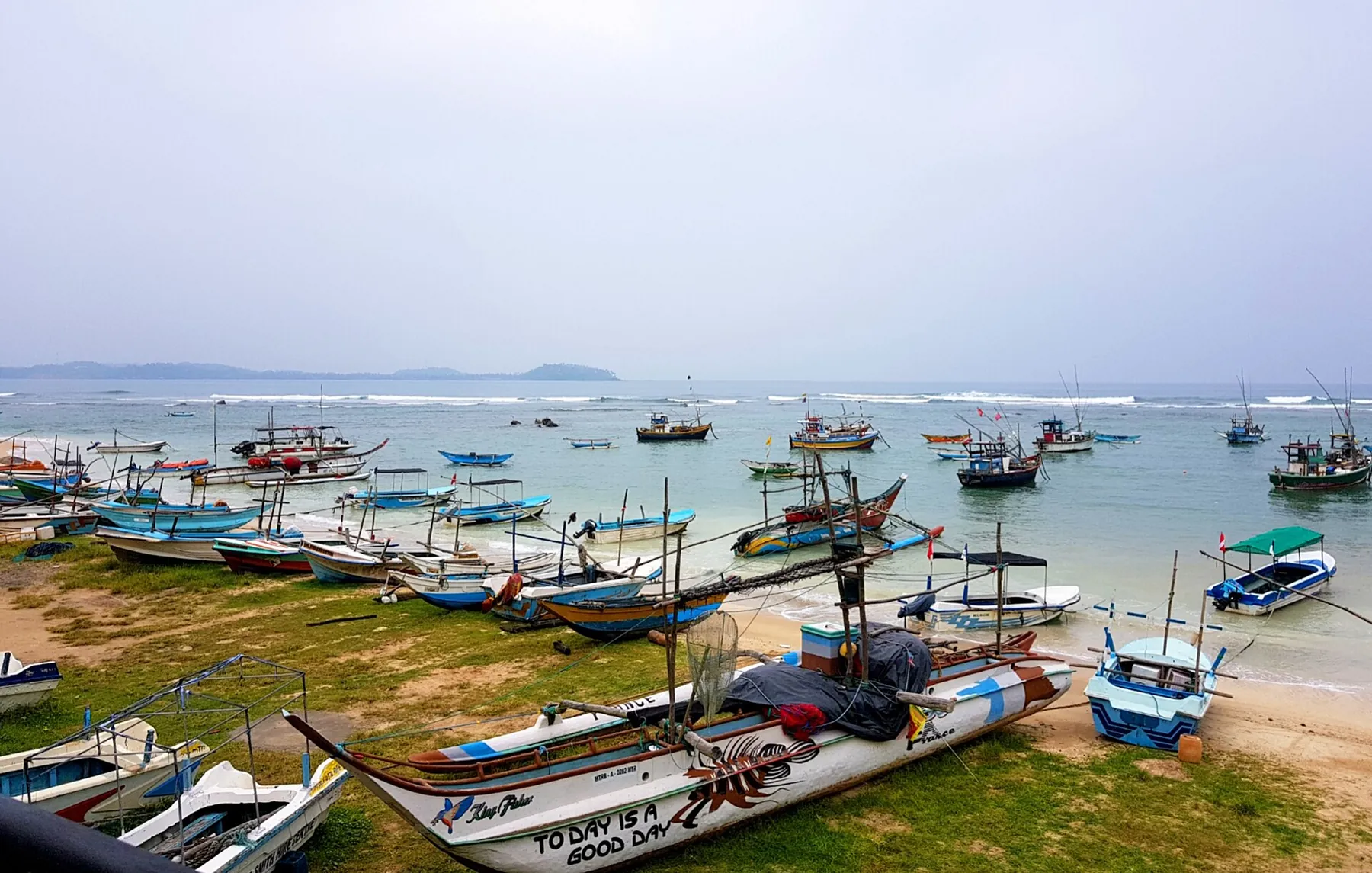
A wide, sandy bay on the south coast between Galle and Mirissa, known for beginner surf lessons, stilt fishermen and Taprobane Island. Surf season runs November to March.